Tree roots are the most common reason an older DFW sewer backs up on a schedule. Here are the signs, why old clay and cast iron joints let roots in, how a camera confirms it, and what actually stops them coming back.
You probably have tree roots in your sewer line if the main backs up every few months, the lowest drain in the house fills first, toilets gurgle, and roots come back on the cable each time the line is cleared. A camera inspection confirms it and shows exactly which joint they are coming through.
Cutting or jetting removes the roots and restores flow, but they grow back through the same open joint. Repairing that joint is what ends it. Bulwark Plumbing clears the line, cameras it, shows you the footage, and prices the repair in writing across Grapevine and DFW.
The clearest sign of tree roots is a main line that backs up on a schedule: it is cleared, works for a few months, and closes again. Roots regrow at a fairly steady rate, so the backups come back at a fairly steady rate too.
None of these signs alone proves tree roots are the cause. A belly, grease or a broken section can look the same from inside the house, which is why the camera matters. Our answer on why a sewer keeps backing up covers the other causes.
Tree roots grow toward water and nutrients, and a sewer line leaks both as warm, moist vapor from any joint or crack that is not sealed. A root finds that opening, grows in through the smallest gap, and then has an unlimited supply of water inside the pipe.
Once inside, the root branches into a fine mat across the pipe. That mat catches toilet paper and waste, the line narrows, and the backup follows. Tree roots do not usually break sound pipe; they exploit an opening that is already there, then widen it as they grow.
Book a camera inspection online and see which joint the tree roots are using. If sewage is coming in right now, call instead.
Because both materials have joints that were never sealed the way modern plastic is, and both are now old. Clay sewer pipe and cast iron drain were standard in DFW until about 1970, and lines from that era are where tree roots show up most.
Clay pipe comes in short sections, so a clay lateral has a joint every few feet. Each joint is a place where vapor can escape and tree roots can enter, and decades of soil movement open those joints further.
Cast iron is past its expected service life here. It corrodes and scales from the inside and cracks, especially along the bottom, and its joints and cracks give tree roots a way in.
DFW sits on Blackland Prairie clay, which swells when wet and shrinks when dry. That movement shifts slabs and the lines under them, opening joints, creating offsets and leaving bellies. Even a newer plastic line can take tree roots where it has cracked or separated.

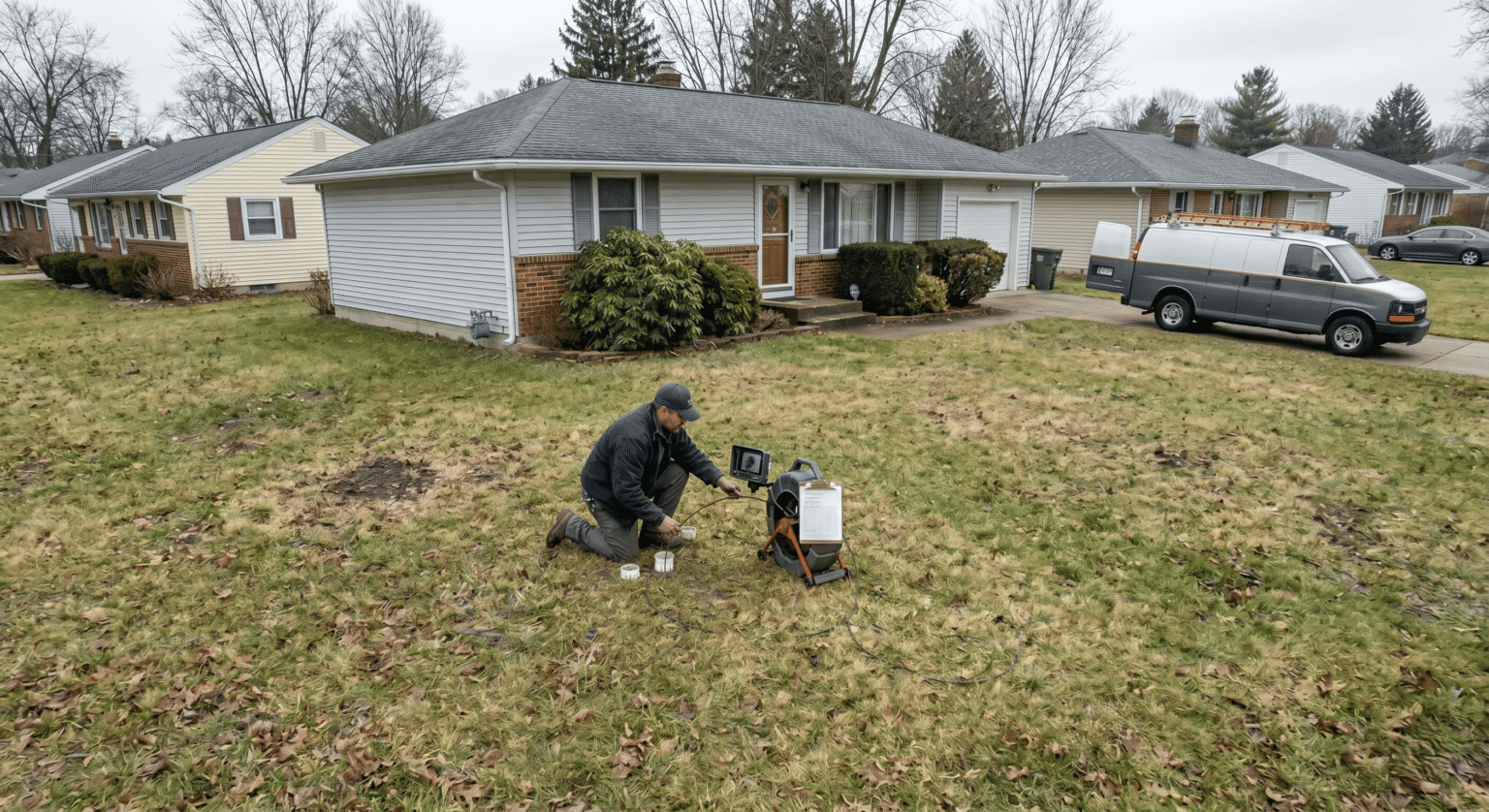
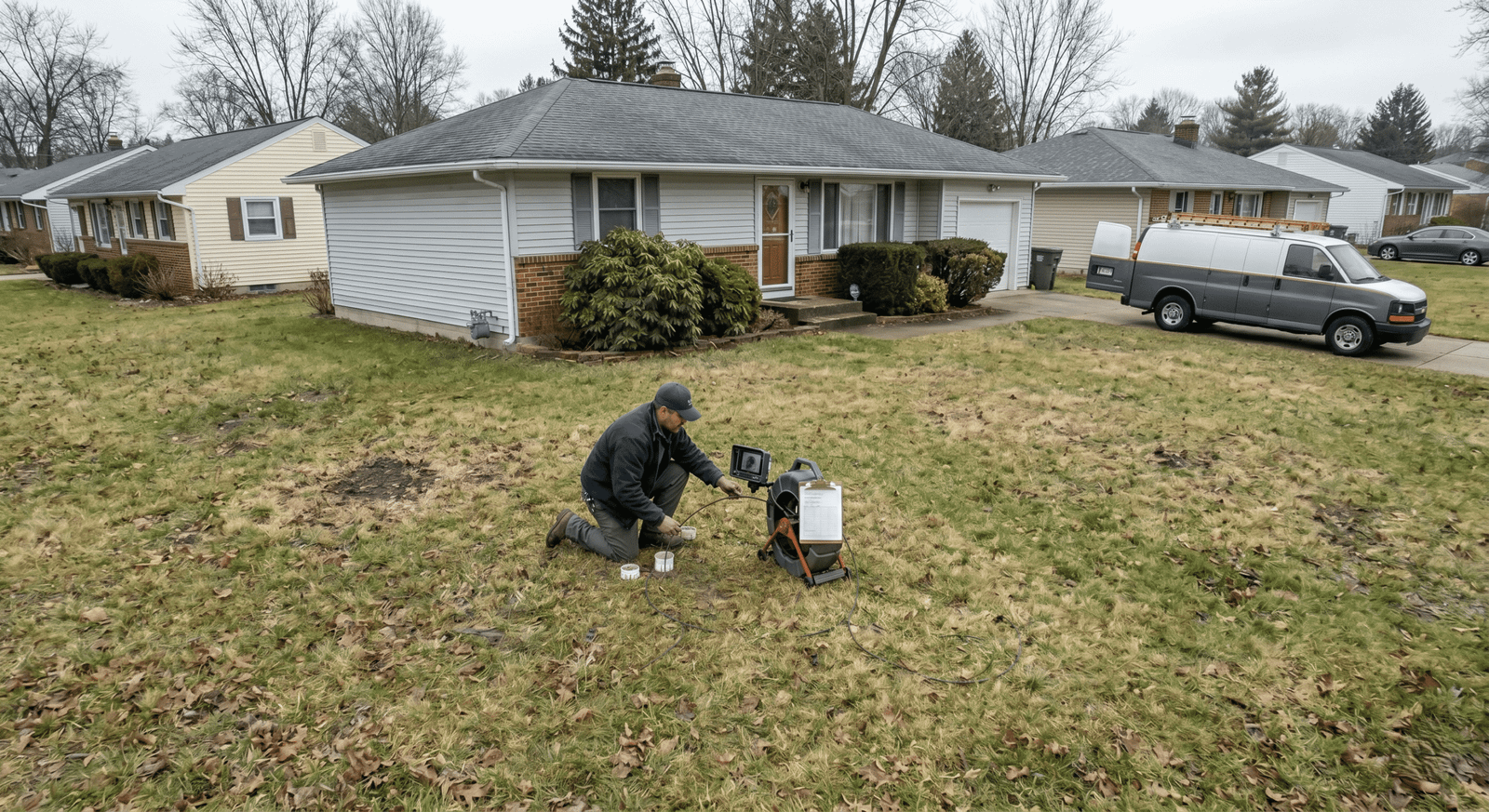
A sewer camera shows tree roots directly: fine hairlike strands at a joint, or a dense mass filling most of the pipe. The counter on the screen gives the distance from the cleanout to each joint where roots are coming in, and a locator above ground marks the spot and its approximate depth.
If the line is backed up, it is cleared first, because a camera cannot see through standing sewage. Then you watch the footage with the technician. That recording answers three questions at once: whether it really is tree roots, how many joints are involved, and whether the pipe around them is sound. Our sewer camera inspection page covers what else the camera can show.
| What the camera shows | What it usually means |
|---|---|
| Fine roots at one joint, sound pipe either side | A single entry point. A good candidate for a spot repair. |
| Tree roots at many joints along an old clay line | The joints are failing along the length. Replacement may make more sense. |
| A root mass at a crack or offset | The pipe has moved or broken, and the roots followed. |
| Roots in a section that is also holding water | A belly with an open joint. Cutting alone will not hold. |
| Roots with soil or missing pipe wall | A break or partial collapse. Jetting is the wrong tool here. |
Cutting and jetting remove tree roots from the pipe; only a repair stops them coming back. Which one is right depends on what the camera shows and how long you want the fix to last.
For the difference between the two cleaning methods in more depth, see hydro jetting vs. a drain snake.
Tree roots come back because cleaning removes the roots inside the pipe but leaves the open joint and the roots outside it. The tree is still there, the joint still leaks vapor, and the cut roots regrow through the same gap, often thicker than before.
That is why we do not warranty a cleaned line against refilling, and why no plumber honestly can. Drain cleaning is the one service we exclude. Regular cleaning can be a reasonable way to manage tree roots for a while, but if the line closes on a schedule, the joint is the problem, and the camera shows which joint it is.
Stop using water everywhere in the house, then call a plumber. Every flush, shower and laundry load has nowhere to go but out of the lowest drain.
If sewage is coming into the house and you cannot stop using water, that is an emergency. Our 24/7 emergency line is answered around the clock. The 60 minute arrival is a target in our core area, not a guarantee, and the dispatcher gives you an actual window on the call along with any after hours rate.
In most cases the homeowner owns the lateral from the house to the city main, so tree roots in that stretch are usually the homeowner’s repair. Where responsibility changes hands varies by city, so if the camera shows the roots are close to the street, ask your city’s public works department before any repair there. Insurance coverage depends on the policy, so check yours or call your agent, and keep the footage and invoices.
We diagnose before we price. A Bulwark technician, our own employee working under Texas license TSBPE 47173, clears the line, runs a camera through it, and shows you where the tree roots are coming in. The diagnostic fee is quoted on the phone before anyone is sent and credited in full if you go ahead. You then get a written flat price for the fix, and the invoice matches it. Sewer line replacement is permitted and inspected where the city requires it and carries our three year warranty.
We work from our shop in Grapevine across Southlake, Colleyville, Keller, Bedford and the rest of DFW. For other common questions, browse our plumbing answers.
The usual signs are backups that return every few months, the lowest drain in the house filling first, gurgling toilets, and roots coming back on the cable when the line is cleared. A camera inspection confirms it by showing the roots at the joint and its distance from the cleanout.
Tree roots usually enter through a joint or crack that is already open rather than breaking sound pipe. Once inside, they grow and can widen the gap, push joints out of line, and add to the damage in old clay or cast iron.
Root treatment products can slow regrowth after a mechanical cleaning, but they do nothing about the open joint that lets roots in, and they will not clear a line that is already blocked. Ask your plumber before pouring anything into a main line.
There is no fixed interval. It depends on the tree, the season, the soil moisture and how open the joint is. The pattern in your own house is the best guide: if the line has needed clearing on a schedule, the roots are regrowing at about that rate.
Not as a first step. The roots are following water escaping from the pipe, and removing one tree does not close the joint. A camera shows which joints are open, and repairing them is what stops roots coming in, whatever is planted nearby.
A cable with a cutting head opens a path through a root mass. Hydro jetting with a root-cutting nozzle clears the joint more completely, which can stretch the time between visits. Neither stops roots coming back, and jetting is only safe on pipe the camera shows is sound.
Less often, because plastic joints are glued or gasketed rather than packed like old clay. Roots can still get in where a line has cracked, separated or bellied as Blackland Prairie clay moved the soil around it.
It is if sewage is coming into the house and you cannot stop using water. If you can stop all water use and nothing is overflowing, a plumber can often tell you on the phone whether it can wait until morning, and that advice costs nothing.
Tell us how often the line has backed up and whether tree roots came back on the cable. For sewage coming into the house, call instead: the line is answered around the clock.
Roots back but nothing overflowing right now? Pick an arrival window and have it confirmed on the page. If sewage is coming in, call instead: the line is answered 24 hours a day.